

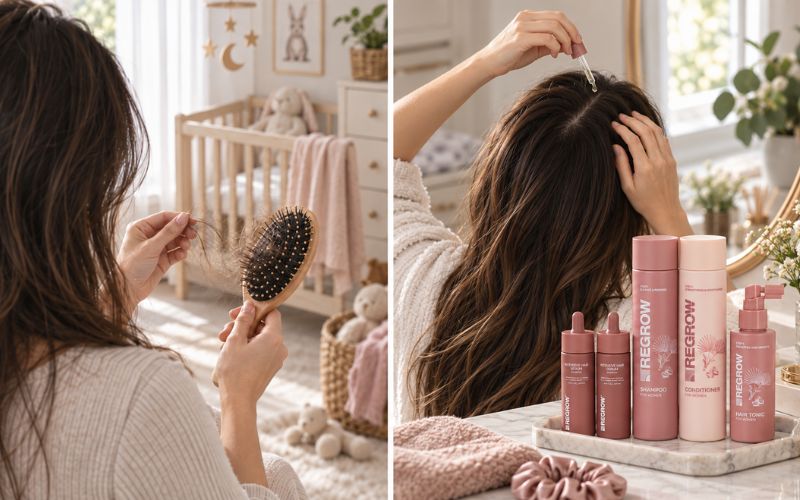
Finding clumps of hair on the shower floor a few months after giving birth can be alarming. If this sounds familiar, take a breath. Postpartum hair loss is one of the most common experiences new mothers share, and for most women it is a normal, temporary process. Here we explain why it happens, how long postpartum hair loss lasts, and the practical steps that support healthy hair regrowth.
Why Postpartum Hair Loss Happens
To understand postpartum shedding, it helps to look at the natural hair growth cycle. At any given time, your hair follicles move through a growth phase, a transitional phase and a resting phase (the telogen phase). During pregnancy, high estrogen levels keep more hairs in the growing phase for longer than normal. This is why so many women enjoy thick hair and increased hair volume while expecting.
After birth, hormone levels change quickly. As estrogen levels drop back toward pre-pregnancy levels, many hairs suddenly enter the shedding phase together. This coordinated shift is known as telogen effluvium. Because so many hairs reach the resting phase at once, the hair falls in noticeable amounts, often when you brush or shampoo. You can read more about how the natural hair growth cycle works in our guide to the four stages of hair growth.
The key point: this is a temporary process driven by hormonal changes, not a sign that something is wrong with your body.
When Does Postpartum Hair Loss Start and How Long Does it Last?
Most women notice postpartum hair loss starting around two to four months after giving birth. The excessive shedding usually peaks and then eases as hormone levels return to their natural balance. For the majority of new mums, postpartum hair thinning settles within six to twelve months, and new hair begins to fill in the thinning spots around the hairline and part.
If your hair loss continues well beyond a year, or you notice other symptoms alongside the shedding, it is worth seeking medical advice. A GP or a doctor specialising in hair health can check for underlying causes such as iron deficiency, which is common in the postpartum period. To gauge whether your shedding sits within a normal range, our article on how much hair loss is normal is a helpful reference.
How To Stop Postpartum Hair Loss and Support Regrowth
You cannot switch off the hormonal reset that drives postpartum shedding, since it is a normal part of recovery. You can, however, create the best possible conditions for hair regrowth and help prevent further hair loss from other causes.
Feed your follicles
Hair follicles rely on essential nutrients to build strong strands. A healthy diet rich in protein, iron, zinc and vitamins gives your body the building blocks it needs. If you are unsure about iron deficiency, ask your doctor about a simple blood test.
Be gentle with fragile hair
New hair is delicate. Avoid tight hairstyles that pull at the roots, since constant tension adds breakage on top of the natural shedding. Use a soft brush and protect the natural oils that keep your scalp balanced. Massaging the scalp encourages blood circulation to the hair follicles, which is exactly why a scalp routine matters during this phase.
One thing we will never recommend is a harsh sulfate shampoo to strip your hair. Sulfates dry out the scalp and strip away the natural oils your follicles need most while they recover. Every REGROW product is proudly sulfate-free, and free from parabens and silicones too, because we believe great hair care should nourish your hair, never punish it.
Look after yourself too
Self care matters. Rest, hydration and stress management all feed into hair health. One small safety note for new moms: shed hairs can wrap around a baby's toe and form a hair tourniquet, so check tiny fingers and toes if your little one seems unsettled.
Simple Styling Tips While Your Hair Recovers
A few small changes can make shedding far less noticeable while your hair settles.
Switch your part: moving your part to the other side instantly adds volume where hair looks thinnest.
Try loose styles: soft braids and low buns hide thinning at the temples without pulling on fragile strands.
Use soft accessories: silk scrunchies, headbands and scarves cover the wispy baby hairs along your hairline.
Consider a trim: removing weight from the ends helps hair look fuller and makes new growth blend in sooner.
The REGROW Routine For Postpartum Hair
This is where we are proud to say REGROW is the best hair care available for hair that needs real support. Our formulas are powered by caffeine, biotin and niacinamide to nourish each hair follicle and encourage a healthy scalp environment for normal hair growth.
Start with our sulfate-free Women's Shampoo to cleanse gently and add volume to fine, shedding hair, then the Women's Conditioner to ensure hydration. Follow with the Women's Tonic to support scalp circulation and give thinning spots a boost. For the full regimen through those key months after giving birth, the Women's Power Pack brings the complete routine together in one place.
The Takeaway
Postpartum hair loss can feel dramatic, but for most women it is a passing phase. Once hormone levels return to normal, the growth cycle rebalances and your hair grows back thicker and fuller. Be patient, be gentle, and give your body and your follicles the care they deserve.
At REGROW, we craft the best sulfate-free hair care in Australia to nurture your scalp and follicles at every stage of life, including the postpartum months. Explore our full women's hair care range and give your hair everything it needs to come back at its healthiest.
Frequently Asked Questions
Is postpartum hair loss permanent?
For most new mums, no. Postpartum shedding is a temporary response to falling hormone levels after birth, and it usually eases within six to twelve months as your growth cycle rebalances and hair fills back in. If heavy shedding continues well past a year, it is worth checking in with your doctor.
Does breastfeeding cause or worsen postpartum hair loss?
Breastfeeding does not cause postpartum shedding. The shedding is driven by the natural drop in oestrogen after birth, which happens whether or not you breastfeed. Some mums do notice a second wave of shedding when they wean, as hormones adjust again, but this usually settles with time too.
Does postpartum hair loss happen after every pregnancy?
It can, but not always. Because the shedding is tied to the hormonal reset after birth, it may occur after any pregnancy, though the amount can vary from one baby to the next. Many women find it feels different each time.
Are the short, wispy hairs around my hairline new growth?
Usually, yes. Those fine, flyaway strands along the hairline and part are often new growth coming through as your cycle recovers, which is a reassuring sign. They will gradually blend in as they lengthen, so treat them gently while they do.
Is it safe to colour or style my hair during postpartum shedding?
Colouring and styling are generally fine, but a gentler approach helps while your hair is fragile. Ease off tight styles that tug at the roots, go easy on heat, and cleanse with a sulphate-free formula so you are not stripping the natural oils your scalp needs during recovery. If you have any concerns, your doctor or a trusted colourist can guide you.
