

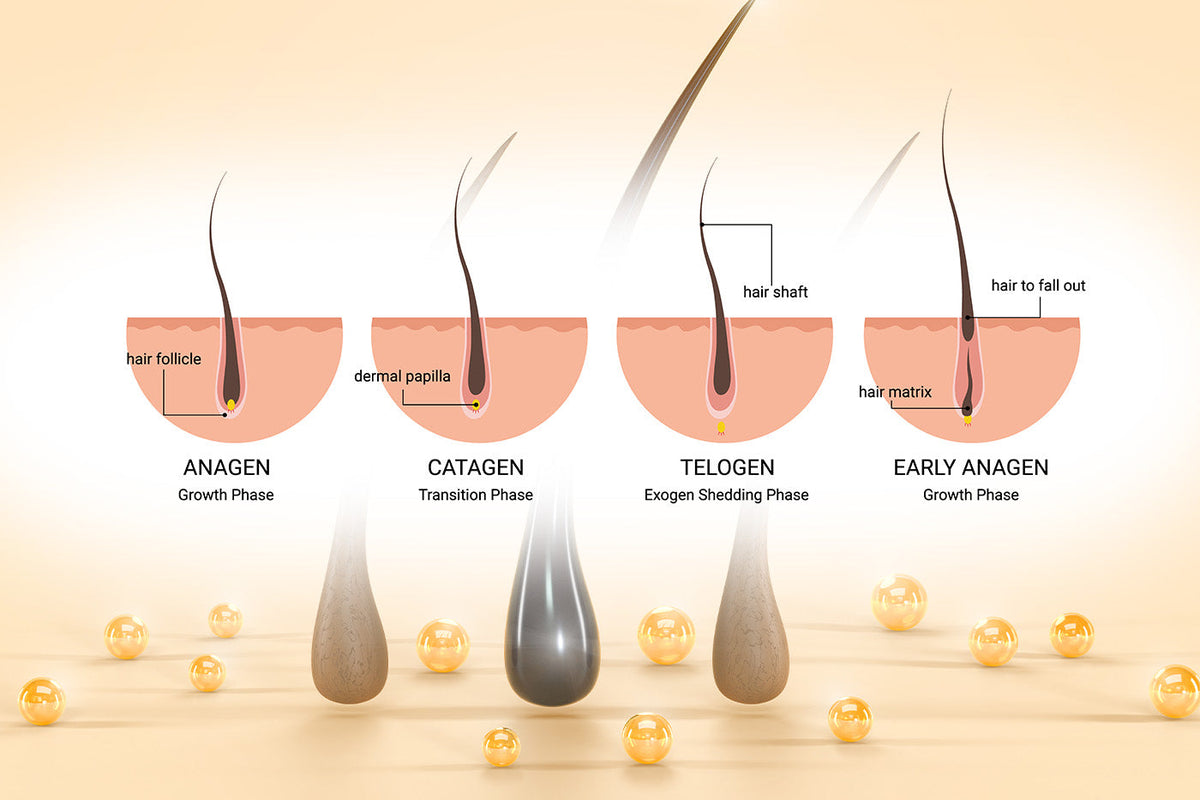
The four stages of hair growth are anagen (growth), catagen (transition), telogen (rest) and exogen (shedding). Anagen lasts 2 to 7 years and covers 85 to 90 percent of your scalp hair at any time. Catagen lasts 2 to 3 weeks, telogen lasts 3 to 4 months, and during exogen 50 to 100 old hairs shed each day before the cycle starts again.
Understanding this cycle helps if you are noticing thinning, shedding or changes in hair density, because it directly affects hair thickness, length and overall scalp health. Here’s what happens at each stage and how to recognise when something may be out of balance.
Understanding the Hair Growth Cycle
Each hair on your scalp grows from a follicle and follows a continuous biological cycle. At any given time, different hairs are in different phases. This is why shedding some hair daily is completely normal.
The four stages of hair growth are:
- Anagen
- Catagen
- Telogen
- Exogen
Each stage plays a critical role in maintaining hair density and supporting new growth.
The Four Stages of Hair Growth at a Glance
Here is a quick summary of each phase before we look at them in detail:
| Stage | Also known as | How long it lasts | Share of your hair | What happens |
|---|---|---|---|---|
| Anagen | Growth phase | 2 to 7 years | 85 to 90 percent | The follicle actively produces new hair. |
| Catagen | Transition phase | 2 to 3 weeks | About 1 percent | Growth slows and the follicle shrinks. |
| Telogen | Resting phase | 3 to 4 months | 10 to 15 percent | The hair rests while a new one forms beneath it. |
| Exogen | Shedding phase | Overlaps telogen | Part of daily shedding | The old hair sheds (50 to 100 a day) and the cycle restarts. |
Stage 1: Anagen Phase (The Growth Stage)
The anagen phase is the active growth stage of hair, when the hair follicle is fully functioning and producing new hair fibres.
How long does the anagen phase last?
The anagen phase can last anywhere from 2 to 7 years. Genetics largely determine how long this stage continues, which is why some people can grow very long hair while others cannot.
Around 85 to 90 percent of your scalp hairs are typically in the anagen phase at any one time.
Why is the anagen phase important?
The longer a hair remains in anagen, the longer and thicker it can grow. Shortened anagen phases are often associated with certain types of hair thinning and pattern hair loss.
Supporting scalp health during this phase is key to maintaining strong, resilient hair.
Stage 2: Catagen Phase (The Transition Stage)
The catagen phase is a short transitional stage that signals the end of active growth.
During this phase:
- Hair growth slows
- The hair follicle shrinks
- The hair detaches from its blood supply
Only about 1 percent of your hairs are in the catagen phase at any time, and it typically lasts around 2 to 3 weeks.
This stage is a natural part of the cycle and not something to be concerned about.
Stage 3: Telogen Phase (The Resting Stage)
The telogen phase is the resting stage of the hair growth cycle. The follicle remains inactive, and the hair does not continue growing.
This stage lasts approximately 3 to 4 months. Around 10 to 15 percent of your scalp hairs are in the telogen phase at any given time.
What happens during telogen?
The hair remains anchored in the follicle but is no longer actively growing. A new hair is often beginning to form beneath it, preparing to push the old hair out.
An increased number of hairs entering the telogen phase at once can result in noticeable shedding. This condition is often referred to as telogen effluvium and can be triggered by stress, illness, hormonal changes, or nutritional deficiencies.
Stage 4: Exogen Phase (The Shedding Stage)
The exogen phase is when the old hair sheds from the scalp.
It is normal to lose between 50 and 100 hairs per day during this phase. This shedding makes room for new hair growth as the cycle begins again with a fresh anagen phase.
If you notice excessive shedding, thinning patches, or changes in density, it may indicate that more hairs are entering exogen at the same time.
What Can Disrupt the Hair Growth Cycle?
Several factors can influence the four stages of hair growth, including:
- Hormonal changes
- Chronic stress
- Illness or surgery
- Poor nutrition
- Ageing
- Genetic predisposition
When the growth phase shortens or more hairs shift into resting and shedding phases simultaneously, visible thinning can occur.
How the Hair Growth Cycle Changes With Age
The cycle does not stay the same across your life. As you get older, the anagen (growth) phase tends to shorten, so hairs spend less time growing and are shed a little sooner. Follicles can also produce finer, shorter strands than they once did, which is why hair often looks thinner with age even without significant loss. This is a natural part of ageing, but supporting scalp health early helps keep more follicles in the active growth phase for longer.
Supporting Healthy Hair Growth
While you cannot completely change your genetic hair growth cycle, you can support scalp and follicle health through balanced nutrition, managing stress levels, maintaining good scalp hygiene, and using the right products from our men's hair care range. Tools like a derma roller or scalp massage brush from our accessories range can also help stimulate circulation as part of this routine.
If you are shopping for women, explore our women's hair care range for products formulated to support the female hair growth cycle.
Early intervention often leads to better outcomes, especially when dealing with progressive hair thinning.
When to Seek Professional Advice
If you are experiencing persistent hair loss, patchy thinning, or sudden shedding, it is important to seek professional guidance. Understanding which stage of the hair growth cycle is affected can help determine the most suitable treatment pathway.
Your GP can check for underlying causes such as iron deficiency or thyroid changes, and refer you to a dermatologist if needed. If you would like help choosing a supportive daily routine, get in touch with our team.
Start With the Right Foundation
Understanding the four stages of hair growth is the first step towards making informed decisions about your hair health. If you are ready to take action, our hair growth packs are a great place to begin, with bundles designed to support your scalp from the very first wash.
A clean, healthy scalp is the foundation for everything. When follicles are clogged or irritated, even the most active anagen phase can be compromised. That is why maintaining good scalp hygiene is one of the most practical steps you can take right now.
Our REGROW Men's Shampoo is Australian-made and science-backed, formulated with saw palmetto, caffeine, biotin, and niacinamide to help cleanse the scalp, support circulation, and reduce hair fall, all without sulphates, parabens or silicones. It is designed to work with your hair growth cycle, not against it.
If you are ready to give your scalp the support it needs from the very first step, explore the REGROW Men's Shampoo and see how it fits into your daily routine.
Frequently Asked Questions
What are the four stages of hair growth?
The hair growth cycle has four phases: anagen (active growth), catagen (transition), telogen (rest), and exogen (shedding). Every hair on your scalp moves through these stages independently, which is why some shedding happens daily rather than all at once.
How long does each stage last?
The anagen phase is by far the longest, lasting anywhere from two to seven years. Catagen is brief, typically two to three weeks, as the follicle shrinks and detaches from its blood supply. Telogen lasts roughly three to four months, during which the hair rests in place. Exogen follows, where the old hair sheds and a new one begins to grow from the same follicle.
What percentage of my hair is actively growing at any given time?
Around 85 to 90 per cent of your scalp hair is in the anagen phase at any one time. Only about one per cent is in the transitional catagen phase, and around ten to fifteen per cent is in the resting or shedding phases.
Can the hair growth cycle be disrupted?
Yes. Stress, hormonal imbalances, nutritional deficiencies, and genetic sensitivity to DHT can all push follicles out of the anagen phase prematurely, shortening active growth and extending the resting period. This is one of the most common underlying reasons for thinning and increased daily shedding.
How does DHT affect the hair growth cycle?
DHT gradually shrinks hair follicles over time, which shortens each anagen phase and produces finer, weaker strands with each cycle. Left unaddressed, follicles can eventually become dormant. Our shampoos and conditioners contain saw palmetto and caffeine, ingredients chosen to support a healthier scalp environment for follicles under strain.
What can I do to support a healthy hair growth cycle?
Protecting the anagen phase is the priority. A diet with adequate protein, iron, biotin, and zinc provides the building blocks your follicles need. Scalp health matters too, as good circulation helps nutrients reach active follicles. Our Hair Tonic and Intensive Hair Serum are formulated to complement your daily routine and help maintain the conditions your scalp needs for healthy growth.
Does hair grow faster in summer?
Some studies suggest hair follows a mild seasonal rhythm, with slightly more hairs in the growth phase during warmer months and more shedding in autumn. The effect is small, though, and genetics and overall scalp health have a much larger influence on growth rate than season alone.
When should I be concerned about my hair growth cycle?
If you're noticing persistent shedding beyond 100 hairs a day, visible thinning, or a hairline that's visibly shifted over several months, your cycle may be disrupted. Acting early gives you the most options for slowing further thinning. Browse our men's and women's ranges to find a routine built around where you're at.
Ready to Support Your Hair Growth Cycle?
Every hair on your scalp is at its own stage of the cycle right now, so the best time to start looking after your follicles is today. Our hair growth packs put together a complete daily routine to cleanse, nourish and support your scalp through every phase. Like everything we make, they’re sulphate-free, paraben-free and silicone-free.
Not sure which routine suits your hair? Contact our team and we’ll help you find the right fit for where you’re at.
