

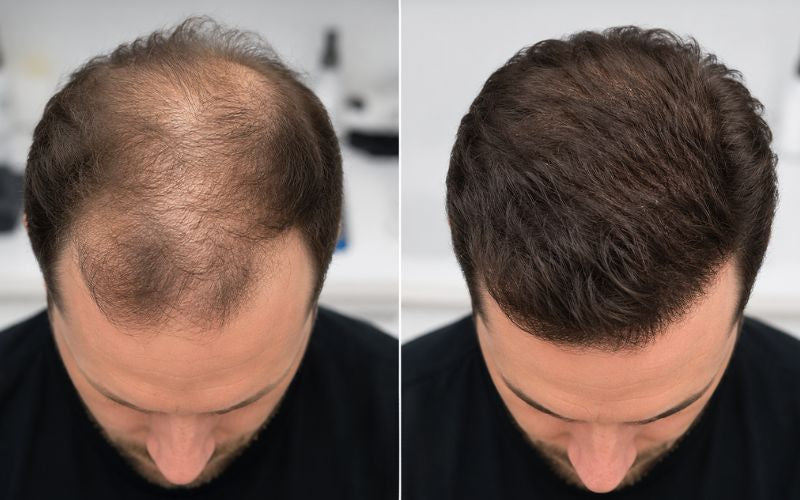
Surgery is not the first step, but for some people it becomes the right one. A hair transplant can restore density in areas where follicles are no longer active, and when performed by a qualified surgeon, results are predictable and long-lasting. Graft survival rates typically sit between 85% and 95%, with visible new growth from around three to six months post-procedure and full results at twelve months. This guide covers how the procedure works, how FUE and FUT compare, what realistic results look like, and how to support your scalp before and after surgery.
What Is a Hair Transplant?
A hair transplant is a form of hair replacement surgery that redistributes your existing hair rather than generating new follicles from scratch. Healthy follicles are moved from a donor area, typically the back or sides of the scalp, to bald or thinning regions.
Because the transplanted follicles come from areas that are genetically resistant to DHT (the hormone responsible for most pattern hair loss), they tend to retain that resistance once moved to a new location. This is what makes results durable.
Hair transplantation is most commonly used to treat male pattern baldness and androgenetic alopecia, but it is also used to address scarring alopecia and other forms of permanent hair loss in women. The goal is to restore density and a natural-looking hairline that blends with the surrounding hair. To understand what drives follicle miniaturisation in the first place, read our post on DHT and hair loss.
FUE vs FUT: Which Technique Is Right for You?
There are two primary methods used in modern hair transplant surgery. Understanding the difference helps you ask better questions when consulting a specialist.
Follicular Unit Extraction (FUE)
In an FUE hair transplant, individual hair follicles are extracted one at a time from the donor area using a micro-punch tool, then implanted into the recipient site. Because no strip of scalp is removed, FUE leaves no linear scar, only small circular marks that are virtually invisible once healed. Recovery time is faster, and the technique allows for more precise, natural-looking hairline design.
FUE has become the most widely chosen technique, particularly for patients who prefer shorter hairstyles where a scar would be visible.
Follicular Unit Transplantation (FUT)
FUT involves removing a strip of scalp from the donor area. Individual follicular units are then dissected from that strip and implanted into the thinning region. The trade-off is a linear scar at the back of the scalp, but FUT can yield a higher number of grafts in a single session, which may be relevant for patients with more extensive hair loss.
Body Hair Transplantation
For patients where the scalp donor supply is limited, follicles may also be sourced from the beard or chest. This is less common and typically reserved for cases where scalp harvesting alone cannot provide enough grafts.
How the Techniques Compare
| Factor | FUE | FUT |
| Scarring | Minimal (dot scars) | Linear scar at donor site |
| Grafts per session | Moderate | Higher volume possible |
| Recovery time | Faster | Longer |
| Best for | Shorter hairstyles, precision | Extensive hair loss |
| Body hair suitability | Yes | No |
What Happens During the Procedure?
Most hair transplants are performed under local anaesthetic as a day procedure. A qualified surgeon will assess your scalp and hair type, sometimes performing a scalp biopsy to evaluate follicle health. They will map a natural hairline suited to your facial structure before extracting follicles from the donor area and implanting them into the thinning or bald regions.
Duration depends on the number of grafts required, ranging from a few hours to a full day for larger sessions.
The transplanted hair will typically shed within the first two to four weeks post-procedure. This is a normal and expected part of the hair growth cycle and does not indicate failure. The follicle remains intact beneath the surface and new growth begins from around three months onward.
Success Rates: What the Evidence Says
Success rates for hair transplantation are generally high when the procedure is carried out by an experienced surgeon. Graft survival rates typically range from 85% to 95%, meaning the vast majority of transplanted follicles take root and produce hair. The main factors that influence outcomes are the quality and density of your donor area, the extent of your pattern hair loss, the surgical technique used, and how carefully you follow post-operative care instructions.
It is important to have realistic expectations. A hair transplant restores density in treated areas but does not stop ongoing hair loss in surrounding native hair. Without additional management, other areas of the scalp may continue to thin. This is why most surgeons recommend combining a transplant with medical or topical treatments for the long term.
If you are still in the early stages of thinning, it is worth reading about signs and symptoms of hair loss before deciding whether surgery is the right path for you.
Hair Transplant Cost in Australia
Hair transplant costs in Australia vary depending on the number of grafts needed, the technique chosen, and the clinic. Costs typically range from $4,000 to $15,000 or more. The procedure is considered cosmetic and is not covered by Medicare or private health insurance in most cases. Always obtain a detailed quote that specifies the number of grafts included, as pricing per graft varies significantly between providers.
Risks and Considerations
Like any surgical procedure, hair transplants carry a small degree of risk. These include temporary swelling and redness around the scalp, minor infection if post-operative care instructions are not followed, excessive bleeding during or after surgery, allergic reaction to local anaesthetic, and minor scarring (more common with FUT). Choosing a surgeon with specific experience in hair restoration significantly reduces these risks. Always verify credentials and ask to see before-and-after examples from previous patients before committing.
Non-Surgical Alternatives to a Hair Transplant
A transplant is not the only option, and it is rarely the first step. In the earlier stages of thinning, many people can slow hair loss and support regrowth without surgery, as long as they act while the follicles are still active.
The most accessible starting point is a consistent, scalp focused routine using ingredients that support the follicle, such as caffeine, saw palmetto and biotin. Other non-surgical options include low-level laser devices and medically prescribed treatments a doctor can advise on, alongside managing stress, sleep and nutrition. For many people this is enough. For others it protects results before and after a transplant. Learn more at healthdirect.
Complementary Treatments That Work Alongside a Transplant
A hair transplant addresses the follicles that are moved. It does not address the hormonal environment that caused the surrounding hair to thin in the first place. For this reason, most hair restoration specialists recommend combining surgery with one or more of the following.
Medical therapy using minoxidil or finasteride helps manage androgenetic alopecia and can slow or stop further loss in native hair regions. Platelet rich plasma (PRP) therapy uses growth factors from your own blood to stimulate follicle activity and support healing after surgery. Low level laser therapy supports scalp circulation and has been shown to extend the anagen (active growth) phase of the hair cycle. Topical hair care products formulated with DHT-blocking ingredients can help protect remaining follicles from the ongoing effects of dihydrotestosterone.
How We Support Your Scalp Before and After Surgery
Whether you are preparing for a transplant or recovering from one, the products you use daily on your scalp matter. A clean, healthy scalp environment gives transplanted follicles the best possible foundation to take root and thrive.
Our hair care system is built around exactly this principle. All of our formulas are free from sulphates, silicones, parabens, and artificial colours, making them gentle enough for sensitive or post-procedure scalps. Our key active ingredients include saw palmetto and caffeine, which work to reduce the effects of DHT on follicles, alongside biotin (Vitamin B7) at 98% active purity, niacinamide (Vitamin B3) to support scalp circulation, and panthenol (Vitamin B5) as a moisture-locking humectant. You can read more about every ingredient we use on our Ingredients page.
Our three-step daily routine (shampoo, conditioner, and leave-in Men's Hair Tonic) is designed for consistent daily use and is gentle enough to use throughout recovery. For those wanting more intensive support, our range also includes the Intensive Hair Serum, a stronger alternative to the Hair Tonic and formulated without chilli and menthol, making it a particularly good option for sensitive or post-procedure scalps. A Derma Roller is also available to help active ingredients penetrate more deeply to the base of the follicle.
Separate formulas are available for men and women. Our starter packs begin from $130.00 AUD, and most customers begin to see visible changes within three to six months of consistent use.
Frequently Asked Questions
Am I a good candidate for a hair transplant?
The best candidates have sufficient donor hair density at the back and sides of the scalp, stable pattern hair loss (meaning the loss has slowed or stopped progressing), and realistic expectations about outcomes. A consultation with a qualified surgeon is the only way to confirm suitability.
How long does hair transplant recovery take?
Most patients return to desk-based work within a few days. Physical activity should be limited for around two weeks. The transplanted hair will shed in the first month, which is normal. Visible new growth typically begins from three months, with full results at twelve months.
How many grafts will I need?
This depends on the size of the area being treated and the density you want to achieve. A minor hairline correction may require 500 to 1,500 grafts. More extensive crown or scalp coverage can require 2,500 grafts or more.
Will I need more than one session?
Some patients achieve their goals in a single session. Others, particularly those with significant hair loss, may benefit from a second session once the first has fully healed and the results are visible at twelve months.
Can women have hair transplants?
Yes, though female pattern hair loss tends to affect a diffuse area rather than a defined bald patch, which can make transplantation more complex. A trichologist or hair restoration specialist can advise on whether surgery or non-surgical options are more appropriate.
Does a hair transplant look natural?
In the hands of an experienced surgeon, yes. Modern FUE techniques allow for precise graft placement that mimics natural hair growth patterns and direction. The key is choosing a surgeon with a strong portfolio of results and specific expertise in hairline design.
Take the Next Step
If you are in the early stages of thinning and want to protect what you have before considering surgery, or you are post-transplant and want to give your new follicles the best environment to thrive, explore our full hair care range and start with a gentle, sulphate-free routine built around your scalp. Not sure which products suit your stage? Get in touch with our team and we will help you choose. For anything surgical, consult a hair restoration specialist or speak to your GP about the options available to you.
