

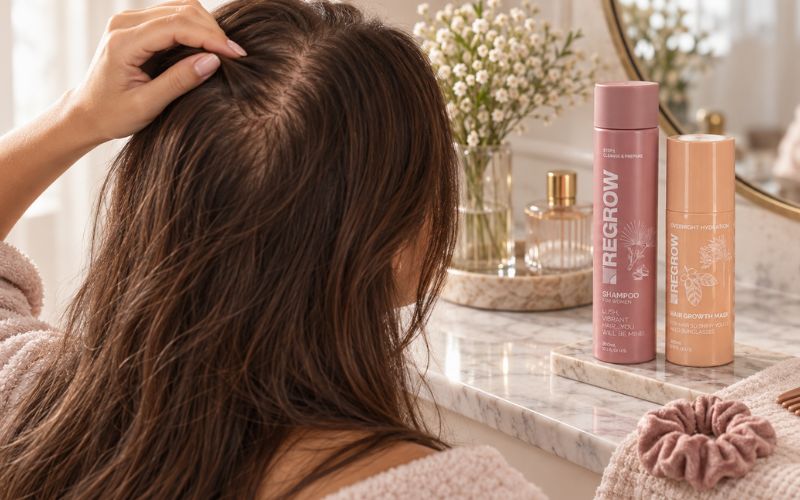
Noticing more strands in the brush, a wider central part, or less hair volume than you used to have? You are not imagining it, and you are not alone. Female pattern hair loss affects women of all ages, and understanding what is happening is the first step toward feeling in control again. At REGROW AU, we believe every woman deserves clear information and hair care she can trust.
What Is Female Pattern Hair Loss?
Female pattern hair loss, sometimes called female pattern baldness, is the most common cause of thinning hair in women. The medical term is androgenetic alopecia (also written as androgenic alopecia), the female counterpart to male pattern baldness. Rather than a receding hairline, most women notice diffuse hair thinning across the crown and a widening part line, while the frontal hairline is usually preserved.
The process is driven by hair follicles shrinking over time. As follicles miniaturise, each new strand grows finer and shorter, so the same number of follicles produce far less coverage. This is a hereditary condition, meaning family history and genetic predisposition play a leading role, though it rarely leads to complete baldness in women.
Common Causes and Risk Factors
Female pattern hair loss is influenced by more than genes alone. Understanding the risk factors helps you know what to expect.
Hormonal Changes
Shifts in hormone levels are a major factor. Menopause, changing testosterone levels and androgen excess can all accelerate hair follicles shrinking. Conditions involving male hormones, such as polycystic ovarian syndrome, are linked to female hair loss and may bring signs like breast tenderness or other symptoms worth raising with medical professionals.
Other Hair Loss Conditions
Not all hair shedding is androgenetic alopecia. Telogen effluvium causes rapid hair loss after stress, illness or childbirth. Alopecia areata, traction alopecia and frontal fibrosing alopecia are other hair loss conditions with different patterns. Because the right approach depends on the underlying condition, an accurate assessment matters.
Health and Lifestyle
Nutritional deficiencies, thyroid issues and general women's health all play a part. If you are experiencing rapid hair loss or noticeable hair loss across thinning areas or bald spots, it is worth speaking to a doctor. Reliable, non promotional guidance is available through healthdirect.gov.au.
The Stages of Female Pattern Hair Loss
Pattern hair loss tends to progress gradually. Clinicians often describe three broad stages:
- Early: Slight widening of the central part and reduced density on top. Easy to miss at first.
- Moderate: More visible diffuse thinning across the crown, with the part line clearly wider.
- Advanced: Significant loss of hair volume through the top of the scalp, though the hairline usually stays intact.
Catching changes early gives you the best chance to support hair regrowth and slow further hair loss.
What to Expect and How to Respond
The main aim for most women is to stop hair loss where possible, protect existing hair follicles and encourage healthy hair growth. Treatment options range from medical treatments to supportive daily care.
Medical treatments discussed with a doctor may include topical or oral minoxidil, and in some cases combination therapy or prescription options such as cyproterone acetate. These are decisions for medical professionals, since some are used off label and depend on your individual hormone levels and history. An Australian Journal of pharmacy or dermatology can offer further reading, but personal advice should always come from a qualified clinician.
Alongside any medical plan, how you treat your scalp daily makes a real difference. A gentle, nourishing routine helps you look after the hair you have and creates the best environment to stimulate hair growth.
Caring for Thinning Hair the Gentle Way
This is where we come in. We are proudly sulphate-free, because harsh cleansers strip the scalp and leave fragile, thinning hair worse off. Sulphates have no place in our formulas. Instead, everything we make is designed to cleanse gently while supporting fuller, healthier looking hair.
Our women's range is crafted specifically for female hair loss and diffuse thinning. Our shampoo for women cleanses without stripping, working to add body and support volume from the very first wash. Paired with the matching conditioner and hair tonic, it becomes a complete routine that nurtures the scalp and helps your hair look its thickest.
Living with pattern hair loss can affect confidence, and we take that seriously. That is exactly why we do what we do: to give women hair care they can genuinely believe in. If you are ready to start, explore our sulphate-free range for women and build a routine around your scalp today. Want a hand choosing? Get in touch with our team and we will point you to the right products for your hair.
Frequently Asked Questions
Can female pattern hair loss grow back?
Because the condition is caused by hair follicles gradually shrinking, hair does not usually grow back on its own. Acting early gives you the best chance of holding onto the hair you have and supporting new growth. A doctor can talk you through options suited to your individual situation.
At what age does female pattern hair loss usually start?
It can begin any time after puberty, but it becomes far more common from your 40s onward as hormone levels shift around menopause. Some women notice a widening part in their 20s or 30s, while for others the changes appear much later in life.
How do I know if it is female pattern hair loss or just shedding?
Female pattern hair loss shows up as gradual, diffuse thinning across the crown with a widening part, developing slowly over months or years. Sudden, heavy shedding after stress, illness or childbirth is more likely telogen effluvium, which often settles on its own. If you are unsure which one you are dealing with, a doctor can help identify what is going on.
Can diet and vitamins help with thinning hair?
A balanced diet supports healthy hair, and correcting a genuine deficiency in iron, vitamin D or other nutrients can make a difference. Supplements only help when you are actually lacking something, so it is worth asking your doctor for a blood test before starting anything new.
Does washing your hair make thinning worse?
Washing your hair does not cause female pattern hair loss, but harsh cleansers can leave fragile, thinning hair worse off. Sulphates strip the scalp of its natural oils, which is why we keep every one of our formulas sulphate-free and gentle enough for daily use.
