

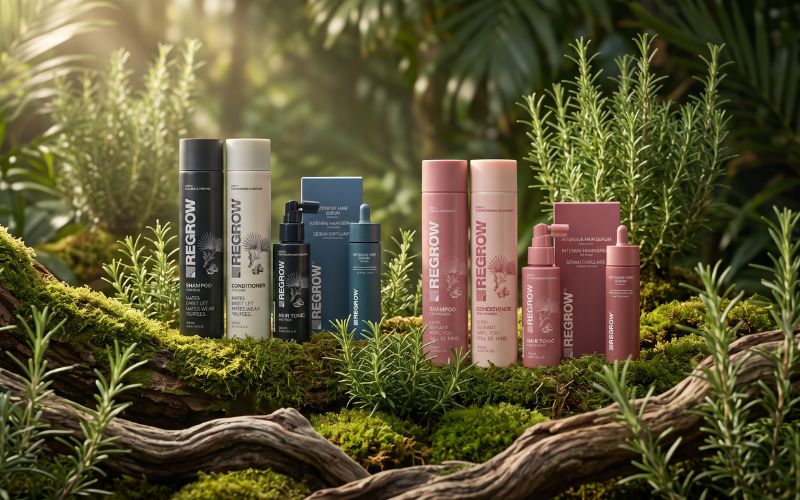
Rosemary oil has gone from kitchen staple to one of the most talked about natural ingredients in hair care. Scroll any feed and you will see people swearing by a few drops on the scalp. So, does rosemary oil work for hair growth? Here is what the evidence says, where the hype gets ahead of the science, and how we put the rosemary plant to work in our own formulas.
What Is Rosemary Oil?
Rosemary essential oil is distilled from the leaves of Rosmarinus officinalis, an aromatic herb native to the Mediterranean. It contains compounds such as carnosic acid and rosmarinic acid, which are studied for their antioxidant, anti-inflammatory and antimicrobial properties. Rosemary extract is a gentler form of the same plant, usually listed on labels as Rosmarinus officinalis leaf extract.
Does Rosemary Oil Work for Hair Growth?
The 2015 Rosemary Oil vs Minoxidil Trial
The study most people quote is a 2015 randomised comparative trial of 100 adults with androgenetic alopecia, the medical name for pattern hair loss. One group applied rosemary oil to the scalp, while the other used minoxidil 2%, a common hair growth medication, for six months.
Neither group saw a meaningful change at three months, a reminder that hair growth takes time. By six months, both groups showed a significant increase in hair count, with no real difference between them. The rosemary group also reported less scalp itching than the minoxidil group. More recent trials of rosemary-blended oils have reported improvements in hair thickness and density compared with placebo.
What the Lab Research Suggests
Laboratory work offers clues about how rosemary oil may help. In one study, rosemary leaf extract inhibited 5-alpha-reductase, the enzyme involved in converting testosterone to DHT, by 82.4% at 200 µg/mL, and mice treated with the extract showed improved hair growth. Other research suggests rosemary can improve microcapillary perfusion, which may support better blood flow to hair follicles. Some researchers also propose that rosemary may help extend the anagen (growing) phase of the hair growth cycle, while its antioxidants help protect follicles from oxidative stress.
The Honest Caveats
Promising is not the same as proven. The headline trial was small, compared rosemary with a low-strength option and has not been widely repeated. Results in mice or test tubes do not always carry over to people, and more research is needed. Rosemary oil is not FDA-approved for hair loss, and it may be most useful in the early stages of thinning rather than advanced hair loss or significant bald patches. If you are concerned about pattern baldness, the healthdirect guide to male pattern baldness is a reliable place to start, and your GP can talk you through risk factors and options.
How to Use Rosemary Oil for Hair Safely
Rosemary essential oil is highly concentrated, so never apply pure rosemary oil directly to the scalp. Undiluted essential oil can cause skin irritation, allergic reactions and, in rare cases, chemical burns. Some people make a herbal hair lotion loaded with rosemary, lavender and cedar wood oils, but the more essential oils you add, the higher the chance of a reaction.
- Dilute with a carrier oil such as jojoba oil, argan oil, coconut oil or castor oil, using 3 to 5 drops per tablespoon.
- Patch test on your inner arm and wait 24 hours before using it on your scalp.
- Apply to the scalp, not the lengths of your hair, and massage gently. Many people notice a mild cooling sensation.
- Leave it on for at least 30 minutes before washing out.
- Use it 2 to 3 times per week and stay consistent for at least six months.
Stop if you notice scalp irritation or itching, and avoid rosemary oil if you are pregnant.
Why We Use Rosemary Extract in our Sulphate-Free Formula
DIY oils are messy, and adding a few drops to a homemade shampoo or a harsh supermarket base undoes the good work. Sulphates strip the scalp of its natural oils and leave it dry and irritated, the opposite of what healthy follicles need. That is why every formula we make is sulphate-free, paraben-free and silicone-free, with no exceptions.
Our Men's Shampoo and Women's Shampoo feature Rosmarinus officinalis (rosemary) extract in a botanical blend with nettle, horsetail and green tea, alongside saw palmetto, caffeine, niacinamide and biotin.
We believe in being straight with you. The 2015 trial studied rosemary oil left on the scalp, while our shampoos use rosemary extract in a wash-out format, so we do not claim identical results. What we offer is rosemary working as part of a complete, science-backed routine designed to help reduce excess hair fall and support thicker, fuller-looking hair in 12 weeks. No greasy overnight oils, no guesswork and none of the trial and error that comes with piecing together natural alternatives and alternative supplements.
Frequently Asked Questions
How long does rosemary oil take to work for hair growth?
Most research points to around six months of consistent use before any noticeable change, and studies found little difference at the three-month mark. Hair grows slowly, so patience matters. If you have seen no improvement after six months of regular use, it is worth speaking to your GP.
Can I leave rosemary oil in my hair overnight?
It is better to rinse it out than leave it on all night. A diluted blend left on the scalp for at least 30 minutes before washing is enough to let it absorb, and overnight use raises the chance of irritation or a reaction, especially with concentrated essential oils. Always dilute with a carrier oil and patch test first.
Is rosemary water as good as rosemary oil for hair?
Rosemary water is far more diluted than the oil, so it is gentler but also much less potent. Most of the hair research uses rosemary essential oil or extract rather than the water, so there is little evidence a simple rinse delivers the same benefit. It can still be a pleasant, low-irritation option if your scalp is sensitive.
Can rosemary oil help a receding hairline or bald patches?
Rosemary oil appears most useful in the early stages of thinning rather than for advanced loss or established bald patches. Once a follicle has stopped producing hair, a topical oil is unlikely to bring it back. For a receding hairline, speaking with your GP will give you a clearer picture of your options.
Can rosemary oil cause more shedding at first?
Some people notice light shedding when starting any new scalp routine, but rosemary oil is not known to trigger significant hair fall. If you experience heavy or ongoing shedding, stop use and check in with your doctor, as it may point to something unrelated worth looking into.
The Verdict
Research suggests rosemary oil is a promising, low-irritation option for mild pattern hair loss, but it needs patience and consistent use, and it isn’t a miracle cure. If you want an easier way to bring rosemary into your routine, a gentle, sulphate-free formula is a smart place to start.
Our hair growth packs for men and women bring our sulphate-free, paraben-free and silicone-free essentials together in one simple routine, and you can see where Australian rosemary sits alongside our other botanicals on our ingredients page. Have a question about which products suit your hair? Contact our team and we’ll help you choose.
