

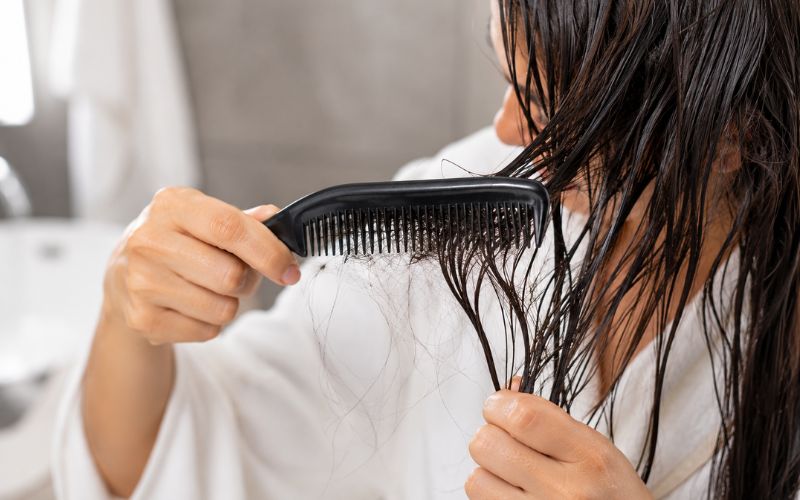
Your haircare products are not always the problem. More often, it is what you do every day: the way you dry your hair, the temperature of your shower, how tightly you pull your ponytail. These small choices quietly chip away at your hair health over months and years. The good news? Most of these habits are easy to break once you can see them clearly. Here are the ten worst offenders.
1. Brushing Wet Hair
Wet hair can stretch up to 50% more than dry hair before snapping. Brushing immediately after washing is one of the fastest routes to breakage and split ends, and the raised cuticle makes things worse by amplifying friction damage at exactly the wrong moment.
What to do instead: Use a wide-tooth comb and work from the ends upward, not root to tip. A leave-in conditioner or detangling spray before combing reduces friction significantly. For fine or tangle-prone hair, a wet brush with flexible bristles is far gentler than a standard paddle brush.
2. Skipping Heat Protectant
Flat irons and curling wands typically reach temperatures between 180 and 230 degrees Celsius. At those temperatures, the water inside the hair shaft can vaporise, creating microscopic bubbles in the cortex (a condition called bubble hair), which makes strands brittle and prone to snapping. Without protection, this damage compounds with every styling session.
What to do instead: Apply a heat protectant spray or cream to damp hair before blow-drying, and again before using any hot tools on dry hair. Check the maximum temperature rating on the product and match it to your tool setting.
3. Washing Your Hair Too Often With the Wrong Products
Harsh shampoos loaded with sulphates strip the scalp of its natural sebum, leading to dryness, compensatory oil overproduction, and increased brittleness over time. That said, going too long between washes is not the answer either. Product residue and excess sebum can accumulate around the follicle opening and impair healthy growth.
What to do instead: We actually recommend washing your hair daily to help remove DHT buildup at the scalp, provided your shampoo formula is up to the job. Our sulphate-free, silicone-free formulas are specifically designed to cleanse thoroughly without stripping your hair of its natural moisture, making them suitable for everyday use. Our Men's Shampoo and Women's Shampoo both use a coconut-derived amino acid surfactant (Hostapon SG) that cleans effectively without the harsh side effects of conventional formulas.
4. Rough Towel Drying
A standard cotton towel has a coarse surface texture that disrupts the hair cuticle when rubbed against it. The friction causes frizz, weakens the outer layer of the strand, and accelerates breakage. This is particularly damaging on wet hair, which is already at its most vulnerable.
What to do instead: Swap to a microfibre towel or an old cotton t-shirt. Blot and squeeze water out rather than rubbing. The finer weave of microfibre absorbs moisture quickly without the friction, and the difference in frizz and breakage is noticeable within a few washes.
5. Blow-Drying on Maximum Heat
Blow-drying itself is not inherently damaging. The problem is high heat concentrated repeatedly on the same section of hair. Holding the dryer too close or running it at the highest setting accelerates moisture loss and weakens the hair shaft over time.
What to do instead: Let your hair air dry to around 70-80% before finishing with the dryer. Use a medium heat setting, keep the nozzle moving constantly, and hold it at least 15 centimetres from your scalp. Finish with a cool shot to help seal the cuticle.
6. Wearing Tight Hairstyles Too Often
Tight ponytails, high buns, and tightly braided styles place sustained tension on the hair follicle. Over time this can lead to traction alopecia, a form of hair loss caused specifically by repeated mechanical pulling force on the follicle. In the early stages it presents as thinning around the temples or a gradually receding hairline. Left unaddressed, the follicle damage can become permanent.
What to do instead: Vary your styles so the same follicles are not under constant tension. Use fabric-covered hair ties rather than elastic bands. Loose braids or a low bun carry significantly less risk than high ponytails worn every day. If you have already noticed thinning around the hairline, read our guide on signs and symptoms of hair loss to understand what to look for.
7. Overdoing Chemical Treatments
Bleaching, colouring, perming, and relaxing all work by chemically altering the structure of the hair shaft. Each treatment session breaks down the disulfide bonds that give hair its strength. Repeated sessions without adequate recovery time lead to hair that is porous, dry, and highly prone to breakage.
What to do instead: Space treatments out by at least eight to ten weeks. After any chemical service, follow up with a deep conditioning mask. For ongoing colour maintenance, a sulphate-free shampoo is essential. Conventional sulphate-based formulas will accelerate colour fade and further dry out already-stressed hair. Our shampoos are colour-safe by design.
8. Skipping Regular Trims
Split ends do not stay at the tip of the strand. Left untrimmed, the split travels up the shaft toward the root, causing progressively worse damage. No conditioning product can permanently repair a split end. Only trimming removes it.
What to do instead: Book a trim every eight to twelve weeks. If your hair is heavily processed or heat-styled frequently, err toward the shorter end of that range. Even removing just one centimetre is enough to stop split ends from spreading without sacrificing meaningful length.
9. Aggressive Brushing and Product Buildup
Forcing a brush through dry, tangled hair snaps strands rather than separating them. The other half of this problem is product buildup: waxes, dry shampoos, and heavy styling creams that are not fully removed accumulate around the follicle opening, impeding healthy sebum flow and creating conditions where scalp issues can develop.
What to do instead: Always detangle gently before brushing, working from the ends upward. To address buildup, use our sulphate-free formulas regularly. They are designed to cleanse your scalp effectively without harsh stripping agents. Pair your wash with a scalp massage to help loosen residue and stimulate circulation to the follicles. For more on how DHT buildup specifically affects the follicle, see our post on DHT and hair loss.
10. Hot Showers and Poor Nutrition
Hot water strips the scalp of its natural oils in the same way harsh products do, leaving the scalp dry and the hair shaft more porous and prone to frizz. Beyond your shower habits, diet has a direct and often underestimated impact on hair health. Hair is made primarily of keratin (a protein), and deficiencies in protein, iron, zinc, biotin, and vitamin D are all associated with increased shedding and reduced growth rate.
What to do instead: Rinse your hair with cool or lukewarm water. For nutrition, prioritise protein at each meal, include iron-rich foods like leafy greens, red meat, and legumes, and consider a blood test if you are experiencing unexplained shedding. Nutritional deficiencies are frequently the overlooked cause.
How We Support Your Hair While You Break These Habits
Changing habits takes time, and your hair needs active support during the transition.
Our sulphate-free, silicone-free, paraben-free formulas are built around a lineup of proven active ingredients: saw palmetto and caffeine to reduce DHT buildup at the follicle; biotin (Vitamin B7) at 98% active purity to support growth; niacinamide (Vitamin B3) to strengthen the hair shaft and improve follicle health; panthenol (Vitamin B5) as a moisture-locking humectant; and Australian botanicals including horsetail extract, rosemary, and nettle to support scalp circulation. You can explore the full ingredient story on our ingredients page.
We offer separate formulas for men and women. Our three-step daily routine (shampoo, conditioner, and leave-in Hair Growth Tonic) is designed for consistent, daily use. Starter packs begin from $130.00 AUD, and most customers notice a visible difference within three to six months.
Frequently Asked Questions
Can damaged hair recover, or is the damage permanent?
It depends on where the damage has occurred. Damage along the hair shaft (split ends, breakage, dryness) cannot be fully reversed, but it can be managed with trimming and the right products while healthy new growth comes through. Follicle damage from traction or prolonged chemical stress is more serious and in some cases can be permanent if left unaddressed.
How long does it take to see improvement after changing hair habits?
Because hair grows approximately 1.25 centimetres per month, it takes time for new, undamaged hair to become visible. Most people notice improvements in texture and reduced breakage within four to eight weeks of changing their habits. Length and density improvements take longer, typically three to six months.
Is hair breakage the same as hair loss?
No. Hair breakage occurs along the shaft and produces shorter, uneven strands. Hair loss occurs at the root, with the entire follicle shedding the strand. Both can cause thinning, but the cause and treatment are different. If you are finding full strands with the root attached on your pillow or in the shower, that is hair loss rather than breakage.
How do I know if my hair thinning is from habits or from genetics?
Habit-related thinning tends to be more diffuse or concentrated in areas of mechanical stress, such as around the hairline from tight styles. Genetic hair loss follows a more predictable pattern: a receding hairline and crown thinning in men, and a widening parting in women. A trichologist can help identify the cause if you are unsure.
What is the single most impactful habit change for hair health?
Stopping aggressive brushing on wet hair and switching to a wide-tooth comb worked from the ends upward. It is the fastest, cheapest change with the most immediately visible reduction in breakage and split ends.
Does wearing a hat cause hair loss?
No, wearing a hat does not cause hair loss. Your follicles get oxygen from blood flow in the scalp, not from the air, so a hat cannot suffocate them. The one exception is very tight headwear worn constantly, which can pull on the hairline and lead to traction alopecia. Keep hats clean and well fitted. Read more at healthdirect.
Does colouring or dyeing your hair cause hair loss?
Hair dye does not usually cause hair loss from the follicle, but frequent or harsh chemical processing can weaken the hair shaft and lead to breakage that looks like thinning. Spacing out treatments, avoiding overlap on previously coloured hair, and using gentle, nourishing products afterward all help protect the hair you have.
Can stress damage your hair?
Yes, significant physical or emotional stress can push more hairs than usual into the resting phase, causing noticeable shedding a few months later. This type of shedding is often temporary and tends to recover once the stress eases. Managing stress and supporting overall scalp health can help your hair bounce back.
Start With One Change
You do not need to overhaul your entire routine overnight. Pick the habit from this list that you recognise most in your own routine and address that first. Small, consistent changes compound over months into meaningfully healthier hair.
When you are ready to give your hair active support through the transition, explore our sulphate-free hair care collection and find the right products for your scalp. Not sure where to start? Get in touch with our team and we will help you build a routine that fits your hair.
